
Original source text in “Bygone Lincolnshire” by William Henry Andrews
https://archive.org/stream/bygonelincolnshi02andruoft/bygonelincolnshi02andruoft_djvu.txt
NE could scarcely find a country town whose aspect is more peaceful — an enemy of the place, if it has one, might say more sleepy — than the little town of Alford. Its grey church tower looks down year after year upon its wide market-place and clean broad streets, and sees little change as time rolls on; and the rooks, cawing on their homeward way to the dark woods of Well, but seldom carry home tidings of any new encroachment by the habitations of men upon their ancestral ” hunting-grounds.” The very railway has been kept at a full arm’s length, and when recently a line of tramcars, with reckless daring, strove to desecrate the decorous streets of Alford with clang of bell and hiss of steam, a few short years sufficed to still the noisy emblem of progress, and to leave the highways once more in the dignified monotony of unbroken peace.
But in the turbulent days when King and Commons argued out their differences with crash of arms, Alford felt the shock of the constitutional earthquake, and showed herself no less able to bear her part than other more important places. Indeed, the condition of things in the little town was such at that time as to suggest that anything but peace reigned in the district, and that bickerings in the market and brawlings in the streets must then have been no infrequent sights and sounds. For in the centre of the town, under the very shadow of the church, lived Sir William Hanby, of Hanby Hall, a staunch adherent of Church and King, whose opinions, doubtless, were of no little weight with many of his poorer fellow-townsmen. But his rule was not undisputed, for in Well Vale dwelt Sir Lionel Weldon, who had thrown in his lot with the Puritans, and had his following also, no doubt, among his neighbours.
The turmoil of the town reached a crisis in June and July, 1645. On the morning of the 27th June, the Royalist leader, Cavendish, marched into the town with a strong force ; the movement was part of an attempt then being made by the King’s troops at Newark and Nottingham to force a passage to Boston, one of the Parliamentary strongholds ; but a minor motive is said to have been the hope of capturing the said Sir Lionel Weldon, a hope in which they had been specially encouraged by Sir William Hanby.
Hanby Hall was made the Royalist headquarters, and the troops lay encamped on the south side of the town, one wing at Bilsby, the other at Holy Well Farm. The low ground round the latter position was at that time but ill-drained, and the marsh proved fatal to many in the subsequent attempt to retreat.
Every effort to seize the person of Sir Lionel proved ineffectual, and the Parliamentary forces, hastily gathered under Sir Drawer Massingberd, though too feeble to attempt an attack, succeeded in keeping the Royalists in check until further help arrived. Late in the day, on July 1st, the Earl of Manchester came up with a considerable force of Parliamentarians, and encamped in Bilsby Field, while news was brought that cavalry and artillery were advancing from Burgh to aid the same cause. No movement was made that day, the Puritan troops being wearied with forced marches, and the Royalist leader being temporarily absent.
On the following day, July 2nd, however, the fight began betimes ; the right wing of the Royal army was vigorously assailed by the troopers of Moody of Scremby, and Payne of Burgh, and completely routed ; numbers perished in the swamp, and the scattered remnant was met at Willoughby by Rossiter, advancing from Burgh, and practically annihilated. The battle was not so easily won in the rest of the field, but at last the whole position was carried by the Earl of Manchester’s forces, the Royalists being scattered with great slaughter.
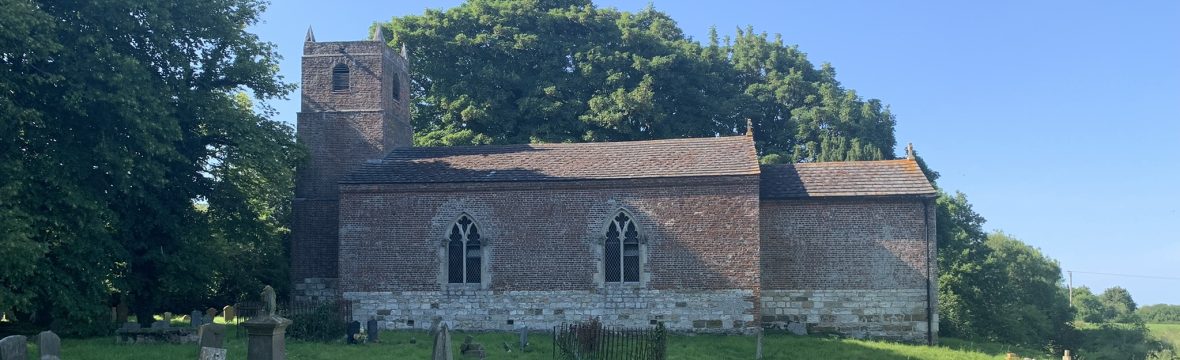
Cavendish got safely away, but Sir William Hanby was among the slain, and his Hall was partially destroyed. The fragment of a regiment serving under Colonel Penruddock took refuge in the parish church, and here, as in so many other instances, the Puritans sullied their victory by the exhibition of their barbarity ; not only did the sacred walls prove no City of Refuge for the vanquished, but the completed victory was signalised by the destruction of almost everything which they contained. Of this desecration, a relic is still to be seen : the tracery of the north and south windows of the Sacrarium of the church is filled with some fragments of old glass, that by their richness of tone put to shame the modern glass beside them, and more than that, prove to us how beautiful must have been “the dim religious light ” within those walls before the passions of men brought the hot breath of war upon the place, to blight the beauty both of men and things.


