
Account of Edmund Oldfield
The following description of the village of Welton le Marsh in 1829 is taken from “Topographical and historical account of Wainfleet and the Wapentake of candle shoe, in the County of Lincoln.” by Edmund Oldfield. The original text can be seen at https://archive.org/stream/atopographicala01oldfgoog/atopographicala01oldfgoog_djvu.txt
The original text rambles between topics, so paragraphs have been grouped together and headings added to increase readability. The spelling of place names around the village varied with time, these have been left as quoted.
Welton
With Boothby is situate in the Wold Division, about seven miles from Spilsby and four from Burgh. The name is derived from the Saxon weald, a wild extent of un-cultivated ground either with or without wood, and tun, an inclosure or town.
the interpretation of the village name origin is different from the modern version “Village with a well or spring”
Domesday account of this parish
Land of Gilbert de Gaad. Soke in Willoughby. In Waletone and Bodebi is one carucate of land to be taxed. Land to one plough. Manor in Bodebi. Sivate had five carpcates of land to be taxed. Land to as many ploughs. Roger, a vassal of Gilbert^s, has there one plough in the demesne, and four villanes, and two bordars, and twelve Bokemen, with three carucates of this land, haying three ploughs. There is a church and six acres of meadow, and forty acres of wood pasture, and sixty acres of coppice wood. Value in King Edward^s time, sixty shillings, the same now. Three oxgangs and a half of this land, yield soke to Wido de Credun.
Land of Gazelin the son of Lambert. Manor in Claxby. Soke in Waletune and Bodebi is two carucates of land and two oxgangs to be taxed. Land to three ploughs.
Land of Ivo Tailbois. In Waleton and Bodebi is two carucates of land and two oxgangs to be taxed. Land to three ploughs.
Land owners in the village
In the reign of Henry III, Jollanus de Hamby held half a knight’s fee in Welleton of the Earl of Arundel. Walter de Welleton held two parts of one knighfs fee of Henry Camer de Wykingeby of the fee of Crequeur, and Lady Cecilia de Creuquer of our Lord the King in capite. Godfrey Pilat held the seventh part of one knight’s fee of Robert de Wylughby and the said Robert of Gilbert de Gaunt. Lord Robert de Tateshal held at the same period lands in Batheby, and William de Weggel lands in Hamby of Lady Beatrix dc Mumby, who held tbem of Peter de Sabaud.
In the succeeding reign (Edward I) the heirs of the Earl of Chester held in Welleton and Boeby, two carucates of land, which Walter de Hamby held for three parts of a knight’s fee, and the forty sixth part of a fee. The Earl of Chester gave this land in marriage with his sister to the Earl of Arundel. Lady Cecilia de Crevequer held in Welton at the same period two carucates of land, which Hugh Fitz Ralph held by two parts of a knight’s fee.
Significant buildings in the village
The family of Hamby above referred to, appear to have been resident in this parish. About half a mile from the church is a large ancient mansion, known by the name of Hanby Hall. This appellation is undoubtedly a corruption of Hamby Hall.
This supports the story that Hanby Hall was burned down in 1643 (in the poem “The battle of Hanby” – see the article on this site). https://weltonlemarsh.com/?p=550
Information on the deserted medieval village of Hanby can be seen at https://weltonlemarsh.com/2025/01/12/the-lost-village-of-hanby/
The known Hanby Hall (demolished in 1975) was a 17th Century building. The original may have dated to the Norman conquest following the construction and expansion of the Castle and the loss of the village of Hanby in the Black Death in 1348. https://weltonlemarsh.com/?p=296
The advowson of the Church of Welton was given by Matthew de Hamby to the Abbey of Thornton. Walter, the son of the above Walter de Hamby, Knight, married Margaret, daughter of Sir William Willoughby, and Alice, sister and coheir of Walter Bec, Lord of Eresby.
The Abbey of Thornton established the monastic cell in the village (now the site of Thwaite Hall), which was destroyed by Henry VIII during the dissolution of the monasteries in 1537. https://weltonlemarsh.com/2023/06/25/thwaite-hall/
About three hundred yards from Hamby Hall, is a large tumulus or barrow, called Castle Hill, which is supposed to be of Celtic origin.
The Castle seems to most resemble a Norman Motte and Bailey structure rather than an Iron age hill fort. However, there is conjecture among the archaeological community. No serious research has been carried out on the site. https://weltonlemarsh.com/?p=281
Not far distant is another spacious building, of apparently greater antiquity, denominated Thwaite Hall, which is completely encompassed with wood, and surrounded by a deep fosse. The foundations of old buildings may be traced in various places within this fosse.
For details of Thwaite Hall see https://weltonlemarsh.com/2023/06/25/thwaite-hall/
A mill stone was found here a few years back (The water mill referenced in Domesday was on the beck alongside Rhea Lane), and ancient coins are frequently dug up. A Fair, called Thwaite fair, for cattle, sheep, &c. was formerly held here on Old Lady-day, which has recently been removed to the village, but it has long since ceased to be a fair for business, and is now only resorted to for pleasure. The origin of the name of this latter residence, as well as the period when the fair was first held is now unknown. There is a tradition in the parish, that a subterraneous communication subsists between Thwaite and Hanby Halls, but the present occupiers are altogether ignorant of its existence.
For details on the tunnel see https://weltonlemarsh.com/?p=653
In 1317 Sir Robert de Willoughby died seized of an estate in Bodeby valued at thirteen shillings and fourpenee per annum. The manor of Hanby is enumerated amongst the possessions which William, the ninth Lord Willoughby was seized of, at his death in 1525. Peregrine Lord Willoughby devised at the period of his dissolution in 1601 the manor of Hanby, to his third son Henry, for the term of rixty years, with reversion to the heirs of Robert, his eldest son.
In 1334 John de Rig paid a fine of six marks for a license, to alienate for the support of the Chaplain of the Church of Saint Martin, in Welton juxta Orby, a lay fee, consisting of one toft, with twenty three acres of land in Croft and Welton aforesaid, ad manum mortuum.
In 1340 Henry de Bello Monte, Earl of Buchan, held of the King the lands in this parish appertaining to the fee of Gaunt. These estates were also held by his grandson Sir Henry de Bello Monte at his death in 1375.
There was a manor in this parish in the reign of Henry III, belonging to the Croun fee.
By the inquisition taken at the death of Mr. Gilbert Pinchbecke, who died in 1528, it appears that he was seized of the manor of Syrlamberds in Welton and elsewhere. He left issue one son Richard who was found hb heir. Was this manor the same which was held in this parish by Gazelin the son of Lambert when the Domesday survey was taken ?
The Manor house held by Lambert is the current Old Post Office.
A. D. 1673 Thomas Elward of Skendleby, died seized of property in this parish, held of the manor of Monksthorpe.
The Church
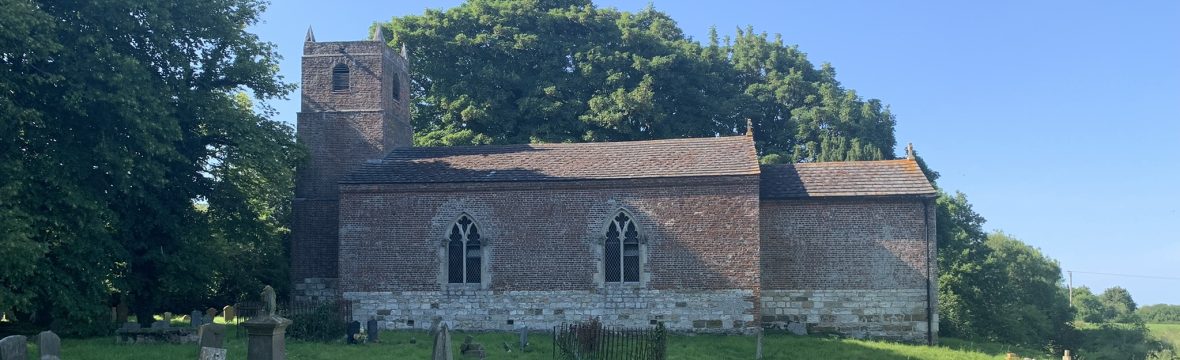
The Church of Welton is dedicated to Saint Martin. The present building was erected in 1792 It is a neat and substantial edifice, composed of brick and stone. It consists of a nave and chancel. A belfry over the west end of the nave contains a small bell, inscribed Thomas Mears, London, 1792. There is a neat singing gallery and the body of the church is handsomely fitted up with pews, Hollis notices the following inscription in the old church.
Upon a table hung upon the wall in the chancel:
Memoriae Henrici Tayler
Viri digni, in artib magri
quondm Socii CI. Collegii sci
John Baptistse Cant, hie sepulti,
amoris erga dictatum p
familiarem suum G. W. Obiit
19 die Junii 1619.
To. the memory of Henry Tayler, a worthy master of the arts, formerly a Fellow of the College of St. John Baptist, Cambridge, who is buried here. as an evidence of affection by his intimate friend. G. W. He died on the l9th day of June, 1619.
Mi Taylere, Vale quam Mors male sustulit ultra
Expectatum mors, sed nune dominabitur ultra
Qualis enim fueras, fueris popt fatSL superstes
Vir juvenis, doctus, facundus, sale facetus.
Ingeniosus, amans, adamatus, dignus in omni
Celebs ; modestus, quid et hec morientur in unum ?
Mors tua damna tuis, nee in villa profuit ulli
Terra tui terram teneat, meliora supersunt
Farewell Taylor, whose death, contrary to our hopes has unhappily taken hence; but further he shall not prevail. For what thou wast, thou, surviving thy fate shall be. A Man, young, learned, eloquent, witty. Ingenious, loving, beloved, in every respect worthy. A batchelor, modest: and why should these die together? Thy death was to thy friends a loss ; to none, advantage. Let the earth possess the eartb, thy better parts survive.
The living of Welton is an exempt Rectory, valued in the Kings books at £’14. 7s. lO1/2d. Prior to the dissolution the Abbey of Thornton were possessed of the advowson. In 1742 the patronage was vested in the heirs of Sir William Massingberd, in whose descendants it still continues.
The Rev. Joseph Walls, M. A. is the present incumbent of Wclton.
The land around the village
The parish of Welton with the hamlet of Boothby, contains two thousand four hundred and twenty acres of land. The hills are chiefly composed of chalk, and the low grounds of a strong tenacious clay, both of which are very fertile and good. About half the parish is arable, producing excellent wheat, barley, beans and turnips. Lady Willoughby is possessed of the manorial rights.
The parish of Welton abounds with wood, and to the lovers of rural scenery, presents many delightful prospects. The view from tlie summit of the hill, is very noble. The inhabitants have in several instances attained to a great age. Gideon Mumby, who had been the parish clerk of Welton for 60 years, died June 9th, 1818, aged 102. Temperance and sobriety are generally considered conducive to longevity ; but, if common fame may be credited it was not the last named virtue that eked out the protracted span of Mumby’s life. At the village alehouse a two handled cup is shown, that bears the name of Gideon’s mug, from the frequency with which he used it, being so very partial to it, that he would scarcely drink out of any other. This longevity undoubtedly promoted in a great measure by the airy situation of the place, and the excellence of the water of the little gurgling brook which flows through the parish to Willoughby, Hogsthorpe and Chapel Tunnel to the sea.
Population
Welton contained thirty four families in the reign of Elizabeth. The number of inhabitants in 1801 was 184; in 1811, 981; in 1821, 355.
Bequests
In 1726 a Mr. Thomas Ingram left by will the sum often pounds, the interest to be annually distributed to the poor. Two pounds per annum are also payable to the poor out of the estates belonging to Mr. George Cockson.
Military connections
In 1822 a fine healthy looking old man, nearly ninety years of age, was living in the parish, who had been engaged as a veteran in the celebrated fight of Bunker Hill, where he received a slight wound. He had enjoyed a pension as a reward for his services upwards of forty years.
Of the family who derived their name from this village, nothing further is known than that one of them had an estate here in the reign of Henry III. Robert de Botheby was summoned to Newcastle upon Tyne, when Edward the first was advancing into Scotland in 1296.

 Welton le Marsh